
The New Age of Guided Selling with AI in the SAP Ecosystem
Abstract
Guided selling is entering a new era. The first wave paired conversational AI with enterprise-grade configuration tools; the second wave is agentic. Instead of a single chatbot that captures requirements and hands them off, a coordinated team of AI agents now plans, reasons, calls tools, and executes multi-step work across sales, engineering, pricing, and approvals. When SAP Variant Configuration (VC) serves as the rule engine, SAP S/4HANA as the digital core, and SAP Configure, Price, Quote (CPQ) as the sales execution layer, these agents can deliver a next-generation Engineer-to-Order (ETO) experience that is autonomous where it should be and deterministic where it must be. This revised edition extends the original framework with a multi-agent architecture, the guardrail patterns that keep probabilistic AI from producing invalid quotes, and the reliability and governance disciplines that production agentic systems require. It also places SAP Variant Configuration where it belongs on the map of AI, as a mature form of symbolic, knowledge-based reasoning, and shows why combining it with generative and agentic AI produces a neuro-symbolic architecture that is both flexible and trustworthy.
1. Introduction
Traditional sales cycles suffer from fragmented requirement gathering and misalignment between sales promises and engineering realities. With conversational AI, organizations can automate requirement collection in a natural, verbal style, creating a seamless bridge between customers and internal stakeholders.
The SAP ecosystem comprising SAP S/4HANA, SAP Variant Configuration, and SAP CPQ: provides the foundation for realizing this vision. AI chatbots capture customer intent; SAP VC ensures technical and product rule compliance; SAP CPQ drives pricing and proposal generation; and S/4HANA connects the process to real-time transactional and historical data.
1.1 Configuration Was AI All Along
Variant Configuration is often treated as a niche ERP capability, but in AI terms it is a form of symbolic AI known as knowledge-based configuration. A manufacturer's engineering expertise is captured in a knowledge base: classes and characteristics describe the product, production rules (preconditions, selection conditions, and procedures) define what follows from each choice, and a constraint-based reasoning engine works out which combinations are valid, in any direction. Choose a voltage and the valid motors narrow; choose a motor and the valid voltages narrow. Every configuration that reaches a quote is buildable and correctly priced.
This is not a new idea. Product configuration was one of the first commercial uses of AI: XCON (originally called R1), built around 1980 to configure Digital Equipment Corporation's VAX computer systems, is among the best-known expert systems in the history of the field [3]. SAP Variant Configuration belongs to the same tradition, and SAP still calls its compiled product models knowledge bases.
It helps to place the technologies in this paper on the broader map of AI:
| Type | How it works | Example |
|---|---|---|
| Symbolic AI (knowledge-based systems, expert systems) | Explicit facts and rules written by experts; the engine reasons over them | SAP Variant Configuration, classic expert systems |
| Statistical / machine learning | Learns patterns from data; makes predictions | Demand forecasting, recommendation engines |
| Generative AI (large language models) | Learns language from huge text corpora; generates responses | ChatGPT, Claude, SAP Joule |
| Agentic AI | Language models that plan, use tools, and take actions | Multi-agent assistants that orchestrate work across systems |
The architecture in this paper combines generative and agentic AI with symbolic AI. In AI research this pairing is called neuro-symbolic AI: neural models such as language models and agents provide flexibility and natural interaction, while symbolic models such as the VC knowledge base provide precision and guarantees. For configurable products, the combination is not optional. It is the only way to make AI both easy to use and safe to trust.
1.2 From Conversation to Action
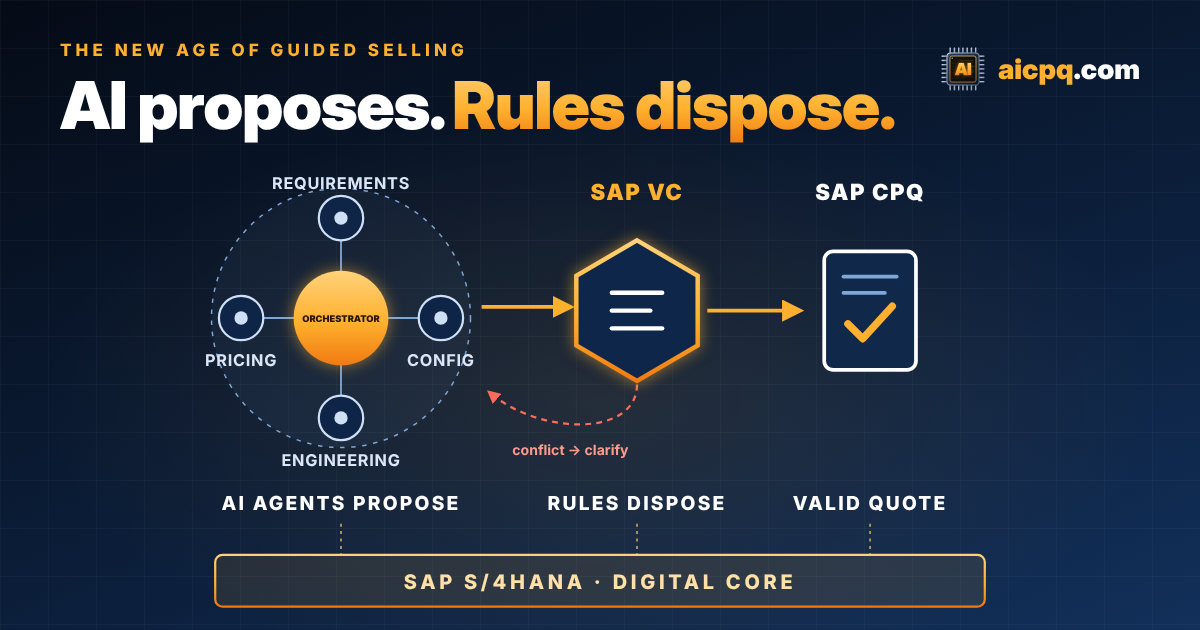
Since the first edition, AI has moved from conversation to action. Agentic systems do not just answer questions; they decompose goals into plans, select and chain tools, recover from errors, and complete work without step-by-step human direction. That shift turns guided selling from a smarter front end into an autonomous sales operation. It also raises the stakes: an agent that can act can also act wrongly. The thesis of this edition is simple. AI proposes, rules dispose. SAP VC and CPQ supply the deterministic rules that make agentic autonomy safe enough for transaction-critical quoting.
2. Conversational AI as the Frontline of Guided Selling
2.1 Natural Language Requirement Gathering
Conversational AI chatbots capture requirements in plain speech or text, ensuring customers no longer navigate rigid forms. Through contextual dialogue, the chatbot probes for missing details and validates answers against known configuration rules.
2.2 Enhanced Experience and Accuracy
This approach improves accuracy while giving customers a more natural, consultative experience, similar to working with a seasoned sales engineer.
2.3 Voice as a First-Class Channel
Customers and field sales teams do not always type. A real-time voice pipeline (telephony, speech-to-text, LLM reasoning, and text-to-speech, streamed end to end with sub-second response targets) lets a customer describe needs on a phone call exactly as they would to a seasoned sales engineer. The same agents, rules, and validation sit behind every channel, so a requirement captured by voice is held to the same standard as one entered in a portal.
3. From Chatbot to Agents: A Multi-Agent Guided Selling Architecture
A single chatbot struggles to hold the whole sales cycle in one context. The agentic model decomposes the work across specialized agents, each with its own role, scoped permissions, tool access, and memory, coordinated by an orchestrator:
- Orchestrator Agent: Owns the customer conversation, decomposes intent into an execution plan, routes each step to the right specialist, and synthesizes the results into a single coherent response.
- Requirements Agent: Gathers and normalizes requirements, probes for missing details, and maps plain-language needs onto product characteristics and values.
- Configuration Agent: Submits candidate configurations to SAP VC through SAP CPQ, receives conflicts and inconsistencies as structured feedback, and explains to the customer what can and cannot be done.
- Pricing and Deal Desk Agent: Requests pricing from SAP CPQ, checks discounts and margins against policy thresholds, and assembles approval packages for anything outside standard terms.
- Engineering Agent: Packages true engineer-to-order exceptions with complete specifications for engineering review, so engineers see only the requests that need them.
- Operations Agent: Monitors the health of every integration the other agents depend on, remediates common failures automatically, and escalates what it cannot fix.
Each agent runs the same perceive, reason, act loop: it perceives through tools and data, reasons over context, and acts through defined interfaces. Separating roles keeps each agent focused, limits what any one agent is allowed to change, and makes the system easier to test and govern.
4. The Deterministic Guardrail: Tools, Rules, and Structured Output
Large language models are probabilistic. Quotes cannot be. The architecture therefore never lets an agent's free-form text become a configuration, a price, or an order. Four patterns enforce this:
- Tools, not text: Agents interact with SAP VC, CPQ, and S/4HANA only through defined function calls with strict schema validation for characteristics, values, quantities, and price requests.
- VC as the source of truth: Every candidate configuration is evaluated by the VC knowledge base. Conflicts come back to the agent as structured feedback, which the agent turns into a clarifying question rather than a guess.
- Structured output: Agents emit machine-parseable payloads that SAP CPQ consumes directly, so nothing downstream depends on interpreting prose.
- Scoped authority: Agents can read master data and draft quotes. Releasing pricing exceptions, accepting non-standard terms, and submitting orders remain with people or with explicit policy.
5. Orchestrating the Sales Cycle via Automated Workflows
Once requirements are captured, the chatbot triggers automated workflows:
- Sales: Receives validated requirement sets for pricing and deal strategy.
- Marketing: Gains insight into market demand patterns and positioning opportunities.
- Engineering: Reviews system-generated specifications for feasibility and design validation.
These communications flow via email or embedded SAP workflows, ensuring alignment across teams. Being linked to the original AI chatbot conversation, the session can continue with each division in a conversational manner.
In the agentic model these workflows are event-driven and scheduled rather than manually triggered. Agents follow up on expiring quotes, route approvals to the right approver with the context already assembled, chase missing engineering input, and run headless on a schedule, surfacing only exceptions. The deal desk stops reviewing every quote and starts reviewing only the ones the rules flag.
6. SAP Landscape for Agentic Guided Selling
6.1 SAP Variant Configuration (VC): The Rule Engine
At the heart of the solution is SAP Variant Configuration, which defines product rules, dependencies, and constraints. As the foundational configuration engine:
- VC ensures that every requirement captured by the chatbot translates into a technically valid product configuration.
- Rules and dependencies prevent invalid feature combinations and guide the chatbot in asking clarifying questions and notifying the user in detail what can and cannot be done.
- In the agentic model, VC is also the guardrail that every configuration agent must pass through before a quote can exist.
6.2 SAP S/4HANA: The Digital Core
SAP S/4HANA provides the real-time backbone for:
- Accessing historical sales and manufacturing data.
- Performing profitability and cost simulations.
- Acting as the system of record for master data used in both VC and CPQ.
6.3 SAP CPQ: The Guided Selling Layer
SAP CPQ integrates directly with VC and S/4HANA, enabling:
- Real-time guided selling interfaces.
- Automatic generation of customer-ready proposals and quotes.
- Pricing logic aligned with variant configuration rules.
- A defined tool surface that agents call to configure, price, and assemble quotes.
6.4 SAP BTP and SAP Business AI: The Agent Runtime
SAP is building its own AI agents, branded Joule Agents, on SAP Business Technology Platform (BTP), and provides Joule Studio for customers to build their own [1]. BTP already connects to S/4HANA and SAP CPQ, governs which users and systems can access SAP data, and maintains a central registry of the agents in use [1]. SAP has also adopted open industry standards so that agents from other vendors, such as Microsoft, Google, and AWS, can work alongside SAP's agents rather than around them [2]. SAP is extending into quoting as well: its announced Deal Closing Assistant is designed to create quotes, check pricing, and route approvals [1]. What the platform does not provide is the rule check that makes an AI-generated configuration trustworthy. That check still comes from SAP Variant Configuration, and connecting agents to it through validated tools, as described in Section 4, is the central integration task this framework addresses.
7. Memory and Context: Selling Across Sessions
Complex configurations rarely close in one conversation. Agents need memory that outlasts a session:
- Semantic memory: Durable facts about the customer, installed base, preferences, and past purchases.
- Episodic memory: Retrieval over past conversations and quotes, so a returning customer picks up where they left off.
- Working memory: Compressed context for long-running configurations, so the agent keeps the full picture without losing precision.
8. Intelligent Feedback Loop: Data-Driven Optimization
By blending conversational AI with SAP VC, CPQ, and S/4HANA, businesses can:
- Compare proposed configurations with historical sales data to identify winning combinations.
- Benchmark against manufacturing performance data to detect risks.
- Optimize engineer-to-order proposals for both customer satisfaction and operational efficiency.
Agents make this loop continuous rather than periodic: scheduled analysis jobs compare recent quotes against win/loss outcomes and manufacturing performance, and feed the findings back into the recommendations the configuration and pricing agents make.
9. Trust, Reliability, and Governance
Autonomous AI is only as valuable as its reliability under load and failure. Operating agentic systems in production makes the requirements concrete:
- Observability and audit: Every agent decision and tool call is logged, so any quote can be traced back to the conversation, rules, and data that produced it.
- Self-healing operations: Continuous health probes detect degraded integrations, common failures are remediated automatically, and only unresolved incidents reach people.
- Human-in-the-loop checkpoints: Pricing exceptions, non-standard engineering, and contractual commitments always stop for human approval.
- Security: Authenticated endpoints, validated inbound requests, credential isolation between agents, and least-privilege access to SAP systems.
- Cost and latency: Model tiering, provider abstraction with fallback, streaming responses for real-time channels, and scheduling heavy workloads into lower-cost inference windows.
- Debugging the non-deterministic: Tracing silent provider errors, format mismatches, and timing races to root cause is part of normal operations, not an exception.
10. Human + AI Collaboration
- Sales: Focuses on building relationships while AI ensures accuracy.
- Marketing: Gains predictive insights into trends and customer demand.
- Engineering: Validates configurations without handling repetitive queries.
- Deal desk: Reviews only the exceptions agents surface, with the full context already assembled.
The VC engine guarantees feasibility, while AI scales human expertise.
11. Future Outlook
The next step is agent-to-agent commerce. A buyer's procurement agent will negotiate directly with a seller's guided selling agent, exchanging requirements, alternatives, and terms in structured form, while each side's rules engine guarantees what it can promise. Voice-driven assistants on SAP BTP will validate configurations against VC rules in real time and recommend optimal designs, positioning businesses to deliver mass customization at scale while maintaining engineering rigor. The companies that win will be the ones whose product rules are clean enough for machines to trust.
12. Conclusion
The new age of guided selling is no longer just a conversational front end on top of SAP. It is a team of AI agents that plan, act, and coordinate across the sales cycle, held to account by SAP Variant Configuration in S/4HANA and executed through SAP CPQ. Agents bring speed, reach, and tireless follow-through; the rule engine brings feasibility and trust; people bring judgment where it matters most. Bridging decades of proven configuration technology with agentic AI is how intelligent systems will augment human decision making, automate complexity, and unlock innovations once thought impossible.
References
- [1] SAP SE, “SAP Sapphire Innovation News Guide 2026.” https://www.sap.com/topics/events/sapphire/innovation-news-guide-2026
- [2] SAP Architecture Center, “A2A and MCP for Interoperability.” https://architecture.learning.sap.com/docs/ref-arch/76ec36
- [3] McDermott, J. “R1: A Rule-Based Configurer of Computer Systems.” Artificial Intelligence, vol. 19, no. 1, 1982, pp. 39-88.